Showing posts with label technology. Show all posts

30 November 2012

How important exactly is science to the economy?

When US senator Marco Rubio failed to acknowledge that the Earth was billions of years old during an interview for GQ magazine, scientifically literate folks pounced. Astronomer and science writer Phil Plait took particular umbrage at Senator Rubio’s dismissive statement that the age of the Earth “has nothing to do with the gross domestic product or economic growth of the United States.” In a Slate article, Plait retorts (emphasis his):

Perhaps Senator Rubio is unaware that science—and its sisters engineering and technology—are actually the very foundation of our country’s economy? All of our industry, all of our technology, everything that keeps our country functioning at all can be traced back to scientific research and a scientific understanding of the Universe.
Cell phones, computers, cars, machinery, medicine, the Internet, manufacturing, communication, agriculture, transportation, on and on … all of these industries rely on science to work. Without basic research none of these would exist.
And all of science points to the age of the Earth being much, much older than Senator Rubio intimates. Astronomy, biology, relativity, chemistry, physics, anatomy, sociology, linguistics, cosmology, anthropology, evolutionary science, and especially radiometric dating of rocks all indicate the Universe, and our home planet Earth, are far older than any claims of a few thousand years. The overwhelming consensus is that the Earth is billions of years old. And all of these sciences are the basis of the technology that is our country’s life blood.

Writing for the New York Times, economist Paul Krugman also criticised Senator Rubio’s view that geological knowledge is unconnected to economic strength:

Coming back to the age of the earth: Does it matter? No, says Mr. Rubio, pronouncing it “a dispute amongst theologians”—what about the geologists?—that “has nothing to do with the gross domestic product or economic growth of the United States.” But he couldn’t be more wrong.
We are, after all, living in an era when science plays a crucial economic role. How are we going to search effectively for natural resources if schools trying to teach modern geology must give equal time to claims that the world is only 6000 years old? How are we going to stay competitive in biotechnology if biology classes avoid any material that might offend creationists?

So far, I’m with Plait and Krugman. After all, isn’t it obvious that scientific literacy is essential for a technology-based economy to flourish? Not necessarily so, according to Slate writer Daniel Engber. Responding to Phil Plait’s article, Engber challenges the view that a country’s economy depends on an absolute knowledge of science. He writes:

What about Rubio’s assertion that the age of the Earth “has nothing to do with the gross domestic product or economic growth of the United States”? That’s the claim that gave Phil Plait “a chill,” since science is “the very foundation of our country's economy.” At Forbes, Alex Knapp declares that “this economy, at its root, is built on a web of scientific knowledge from physics to chemistry to biology. It’s impossible to just cherry pick out parts we don’t like.” If we get it wrong on Earth’s creation, these critics say, the United States will fall apart.
Will it really? It seems to me that Rubio is right. Lots of basic scientific questions have no bearing whatsoever on the nation's short-term economic growth. We can even go much further: Lots of scientific questions don’t matter all that much when it comes to other scientific questions. It’s possible—and quite common—for scientists to plug away at research projects without explicit knowledge of what’s happening in other fields. And when a bedrock principle of science does need to be adjusted—a not-so-unusual occurrence, it turns out—the edifice of scholarship doesn’t crumble into dust. DVD players still operate. Nuclear plants don't shut down.

Philosopher Massimo Pigliucci agrees with Engber. On his blog Rationally Speaking, Pigliucci explains why people like Phil Plait and Paul Krugman (and Pigliucci himself, initially) are wrong to believe that the kind of ignorance of (or disrespect for) science displayed by Senator Rubio is ipso facto damaging to science, or the economy, as a whole:

There is a deeper philosophical reason why Engber is right and people like Phil and myself ought to be more cautious with our outrage at the cutting of scientific budgets or at politicians’ opportunistic uttering of scientific nonsense to gather supporters and votes. Knowledge in general, and scientific knowledge in particular, is not like an edifice with foundations — a common but misleading metaphor. If it were, it would be more likely that, as Phil so strongly stated, everything is connected to everything else, so that ignoring, denying, or replacing one piece of the building will likely create fractures all over the place.
But that’s not how it works. Rather, to use philosopher W.V.O. Quine’s apt metaphor, knowledge is more like a web, with some threads being stronger or more interconnected than others. […] If you see science as a web of statements, observations, experiments, and theories, then it becomes perfectly clear why Engber is right at pointing out that quite a bit of independence exists between different parts of the web, and how even relatively major chunks of said web can be demolished and replaced without the whole thing crumbling. There really is next to no connection between someone’s opinions about the age of the earth and that person’s grasp of the state and causes of a country’s economy.

Pigliucci’s use of the ‘science is a web’ metaphor is persuasive. But before you think that he is letting anti-scientific folks like Senator Rubio, creationists and ‘alternative’ medicine advocates off the hook, Pigliucci clarifies his position on the value of science and evidence-based reasoning (emphasis his):

Still, there is an important point where Phil is absolutely correct and that I think Engber underestimates. What is “chilling” and disturbing about people like Rubio (but not people like Obama) is that they have embraced a general philosophy of rejecting evidence and reason whenever it is ideologically or politically convenient. That is what is highly dangerous.

I can see Pigliucci’s point about how science isn’t a monolithic edifice that will collapse when its foundations are cracked by ignorance and rejection of facts. I accept his argument that science is actually a web, where torn or missing threads in one part may not affect the structural integrity of the whole, or other parts of the web. Still, as Pigliucci concedes, this does not excuse anti-scientific attitudes. A country’s economic prosperity may not be entirely dependent on the scientific literacy of its leaders, but a culture that enables, even encourages, ignorance and rejection of knowledge surely isn’t a healthy one.


1.12.12

11 July 2012

Is eugenics really such a bad thing?

Kenan Malik is a critic of a purely science-based morality, the sort promoted by thinkers like Sam Harris in his book The Moral Landscape (2010). Malik doesn’t believe that ethical issues are amenable to scientific reductionism. In his review of The Moral Landscape, he makes this criticism of Harris’s ideal morality:

Moral norms seem not to emerge through a process of social engagement and collective conversation, nor in the course of self-improvement, but rather are laws to be revealed from on high [by science] and imposed upon those below.

Malik recently wrote a blog post expanding on his analogy of scientific morality as revealed laws (the religious connotation is made obvious in the title of his post). Again, he challenges the assumptions of those like Harris who view morality as simply being a question of facts, which science can discover and present, indisputable. Malik mentions the bioethicist Julian Savulescu, who has argued in favour of a benign form of eugenics that will remove the “genes and proteins associated with poor impulse control as well as those for psychopathy and anti-social personality disorder” while promoting “genes for compassion and moral thinking.”

So far, so controversial.

I am inclined to adopt the scientific view of morality as espoused by Harris and Savulescu, though it is to Malik’s credit that his counter-arguments have made me reexamine my position, if not entirely abandon it. I think that when one accepts a materialist conception of human personality (or the mind), one has to also accept that neurobiological manipulation can alter people's character traits. So why not do so to make them more moral?

Malik rebuts Savulescu’s idea of positive eugenics with examples of how nominally bad traits like aggression can be good in the right context, and vice-versa for nominally good traits like trust and co-operation. He writes:

But is it a good that trust be enhanced in all circumstances? After all, would not authoritarian regimes and even democratic politicians welcome a more trustful, and therefore a less questioning, population? Is aggression always bad? Is the aggression that the Arab masses have shown, and continue to show, in taking to the streets in defiance of brutal authoritarian regimes equivalent to the aggression of those authorities in brutalising and murdering the protestors? And if not does it make any sense to suggest, as Savulescu does, that ‘our futures may depend upon making ourselves wiser and less aggressive’, including through the ‘compulsory’ use of serotonin [a neurotransmitter that contributes to feelings of happiness and well-being]?

Good points. But as I responded in a comment to Malik’s post, what about undeniably pernicious traits like a propensity for sexual predation or rape? For violent psychopathy or homicidal urges? I wrote:

If one accepted a materialist conception of the mind, then wouldn’t it be an uncontroversial good to use medical/scientific means to purge these sorts of tendencies from people? And if you answer “no”, what would be the moral justification for letting a portion of society continually pose a (perhaps fatal) risk to others?

Malik replied that my question was an important one that “gets to the heart of the debate about what we mean by a ‘materialist view of the mind’”, and that he will write a proper post on this topic soon, hopefully within the next few days. I look forward to his (very likely persuasive) answer to the rather utilitarian dilemma my question poses. Stay tuned!


11.7.12

12 March 2012

The (current) limits of neuroimaging


I confess that I’m one of those neuroscience buffs who overestimate the advances made in this field of study. Rejecting dualism comes with a hazard: you tend to idealise any technology that can potentially prove once and for all that the mind is entirely created by the brain. But my idealism has been tempered with a healthy dose of realism after reading this article - it describes the limits of current neuroscience technology like functional magnetic resonance imaging (fMRI) and shows the dangers of overselling the usefulness of neuroimaging. Conversely, it also touches on the danger of ignoring the contributions of neuroimaging, particularly in disciplines like psychiatry. This paragraph makes it quite clear that psychiatry needs to do some serious house cleaning if it is to remain a credible science.

Neuroimaging research also could completely change how we think about psychiatric disorders by rendering obsolete the idea that using discrete diagnostic categories such as schizophrenia or attention-deficit/hyperactivity disorder (ADHD) provides the best way to understand the underlying disorders. Today, these diagnoses are based on formal criteria, outlined in the American Psychiatric Association’s Diagnostic and Statistical Manual, that specify symptoms for each disorder. But these criteria have no basis in neuroscience. In fact, the psychiatric community has become increasingly concerned that traditional diagnostic categories actually obscure the underlying brain systems and genes that lead to mental health problems. In addition, a growing body of evidence indicates that many psychiatric problems lie on a continuum rather than being discrete disorders, in the same way that hypertension reflects the extreme end of a continuum of blood pressure measurements. Neuroimaging provides us the means to go beyond diagnostic categories to better understand how brain activity relates to psychological dysfunction, whereas using it to “diagnose” classical psychiatric disorders could obscure, rather than illuminate, the true problems.


I’m still a staunch materialist, and all this new information doesn’t suggest that dualism is a valid idea. What it does suggest is that although the field of neuroscience is discovering more and more about how the brain gives rise to consciousness, we shouldn’t attribute discoveries to it that it hasn’t actually made.


HT: Matt O Bee


13.3.12

28 December 2011

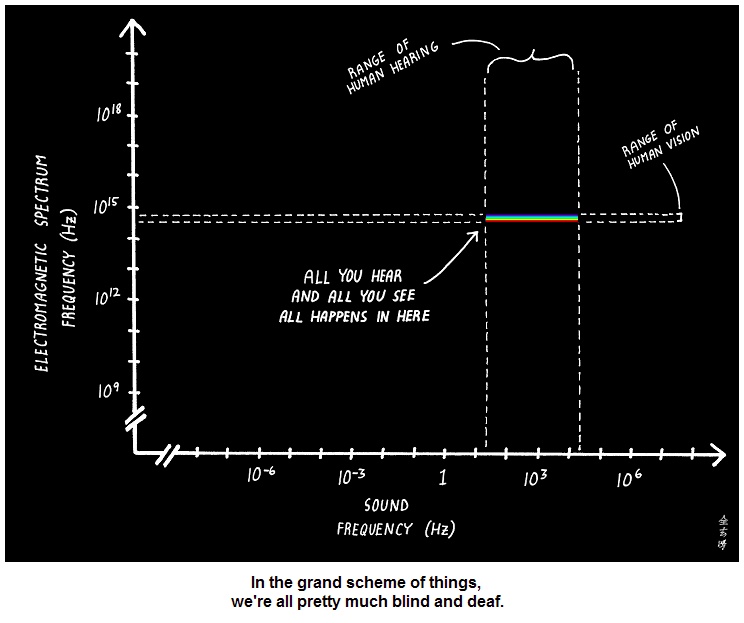
A little perspective on human perception


It’s good to occasionally have a reality check to temper our hubris. But I think it’s only fair to acknowledge that our technology – created through the application of our unique powers of reason and distinctly human ingenuity – allows us to see and hear far beyond our natural limits. Telescopes, microscopes, spectrometers, microphones and stethoscopes are inventions that our species can be rightfully proud of.


HT: PZ Myers


28.12.11

27 September 2011

The end of print?

Sam Harris’s latest blog post spells out in brow-furrowing, lip-chewing detail the gloomy future of the printed book. Fellow bibliophiles are going to find it a depressing read. I do.

Martin at Furious Purpose has commented on the rather dire Melbourne bookshop scene. Borders and Angus & Robertson are gone. My regular supplier of ink-on-dead-trees, Reader’s Feast, is now a famine – they shut shop a few months ago. The only bookstore left that is likely to stock the kind of books I’m willing to pay grossly inflated prices for (thanks Australian government! /sarcasm) is Readings in Carlton. If (when?) that place shutters, I’m going to need therapy.

In this digital, Amazonian age we currently inhabit, book lovers need to somehow make the printed word indispensable, hip even. John Waters has an idea on how to do just that.


HT: Martin


28.9.11

25 July 2011

This is what your soul looks like


This image was in the August 2011 issue of National Geographic magazine. It shows the “color-coded depiction of routes created by a brain’s neural pathways”, made possible by cutting-edge 3D imaging technology. From the accompanying text:

We like to brag about our gray matter, linking smarts to brain cells. But for neuroscientists, it’s also about white matter, the spaghetti-like tangle of nerve fibers, and the networks that carry information between regions of the brain. Who we are — our memories, thoughts, emotions — derives from these wiring connections. The problem was no devices existed to see and decode the neural maze in live subjects. That’s now changing.

Advances in neuroscience and psychology increasingly prove that our minds – constituted of our memories, thoughts, dreams, emotions, decisions – have a physical basis in our brains. As this knowledge becomes more widely spread and accepted, it will revolutionise the way human beings perceive themselves and others. The ramifications for culture, society, law, religion and politics are immense.

For thousands of years people have, to varying degrees, believed in a soul or self that isn’t bound to the physical body, nevermind the specific lump of matter in our skulls. This dualism is apparent in religion, pop psychology, the cultural products we manufacture, even our language – as when we exhort someone to ‘follow your heart’, meaning to trust their ‘gut’ feeling that is supposedly distinct from their brain-derived thinking. I don’t know about you, but all my heart does is pump blood around my cardiovascular system. I do my feeling with my amygdala and my rationalising with my frontal lobes.

The popular conception of the soul or self is becoming untenable. Like the geocentric universe, bloodletting, bodily humours, phlogiston and much of pre-Darwinian biology, mind-brain dualism will eventually end up in the rubbish bin of false ideas. The only thing keeping it from being immediately thrown out is the ubiquitous triumvirate of social inertia, ignorance, and fear.

Those who still believe in immaterial souls and ghosts in machines are on the wrong side of history.


25.7.11


Image by Van Wedeen

21 July 2011

Skepticism, the internet, and Google filters

The Amazing Meeting – an annual conference for skeptics, mythbusters and truthseekers held in Las Vegas – had its ninth gathering last week. A lot of prominent skeptics attended the event, and came away feeling inspired and challenged by the topics discussed. PZ Myers and Daniel Loxton each had their own take on the topic of skeptic outreach: Myers mainly agreed with the gist of one discussion (that skeptics need to focus on the effective communication of their message), but had reservations as to whether the suggested ‘gentle approach’ is the best, or only, way to promote skepticism (I commented on this in a previous post). Loxton seemed more on side with the argument that successful communication requires sensitivity, compassion and respect towards the intended audience. And Steven Novella had some thoughts on the connection between the internet and the growth of the skeptic movement.

I’m going to focus on Novella’s post, because it raises an important, if tangential, point. Novella observes that since the internet allows people to access an unprecedentedly huge amount of information, skepticism gets a boost because people are able to look up the facts on any contentious issue. He’s right about that. To demonstrate his point, Novella ran a Google search on a few skeptic hot words like ‘homeopathy’, ‘intelligent design’ and ‘do vaccines cause autism’. Almost all had a skeptical link on the first results page.

11 April 2011

Anti-vaccination ads in Times Square

Anti-vaxers are going for the jugular this time. Mercola and the National Vaccine Information Center (or rather MIS-information Center) have launched an anti-vaccination ad campaign on the JumboTron in New York’s Times Square, where it will be seen by millions of locals and visitors. The lies and fearmongering must not go unchallenged.

There’s a petition asking CBS Outdoor, the owners of the JumboTron, to stop running the ads. Please sign it, even if you’re not a New Yorker or an American, and spread the word to all and sundry. Misinformation on health matters affects us all, no matter where we live.

Over at the Skepchick website, Elyse Anders has posted links to stories illustrating the harm caused by a significant drop in vaccination rates. When a certain number of kids in any given population aren’t vaccinated, it compromises the ‘herd immunity’ effect that acts to prevent outbreaks of contagious diseases.

Two trusted medical experts that I know of have written extensively on vaccines and the global anti-vax movement. Dr Ben Goldacre, who is also an investigative journalist, has covered these issues in newspaper articles, interviews, blog posts and his book Bad Science (2009). Dr Steven Novella is a neurologist and educator who has written about the efficacy, safety and necessity of vaccines on his blog NeuroLogica. I highly recommend you read what these two doctors have to say about the vile anti-vax campaign that needlessly puts children at risk of disease and death.

On a lighter note, here’s an awesome poem by the Digital Cuttlefish on the Times Square anti-vax ads.


12.4.11

22 March 2011

Two maladies infecting the Japan disasters

Popular perception of the Japanese disasters and the Fukushima nuclear power plant crisis is afflicted with two common maladies: media sensationalism, and anti-modern admonishments against human hubris (because supposedly it was pride in our technological prowess that brought us low). Against these twin poisons, Kenan Malik’s article is the antidote. Malik makes the distinction between two catastrophes: the physical one in Japan, and the mental one fabricated by the media. It is the second ‘catastrophe’ that is infected with the aforementioned maladies.

12 January 2011

Free sex, kid porn, make money fast

My post entitled ‘Cartoon kid porn: evil pedophilia or victimless crime?’ currently sits at the number three spot on this blog’s Top Ten list of most viewed posts. Yet I doubt that the post owes its popularity to the subject matter: a criticism of the hypocrisy and irrationality of anti-cartoon kid porn crusaders, written in the form of a fictional interview. Far more likely that the Googlers were looking for more graphic fare. But since the post and its title contain the keywords kid porn, cartoon porn, pedophilia, dick, ass and the ubiquitous sex, Google’s arcane algorithmic administrations would have served it up as a search result, even if the searcher was after a more titillating link. Basically, I cheated, if unintentionally.

08 December 2010

WikiLeaks: the case for and against

Looks like they got him. Julian Assange now sits in a London jail on rape charges, awaiting possible extradition to Sweden. But I won’t be drawn into this sideshow. I’m more concerned about the ethical issues behind the actions of WikiLeaks. Assange may be the cognitive, directive and even motive force behind it, but his current absence from WikiLeaks won’t lessen the impact the organisation has made on the international landscape. The fallout of ‘Cablegate’ will continue to occupy people’s thoughts and fuel fiery arguments attacking and defending WikiLeaks (and thus Assange).

25 October 2010

“It’s got to do with intention”: The photography of Robert Frank and Elliott Erwitt


Quality doesn't mean deep blacks and whatever tonal range. That's not quality, that's a kind of quality. The pictures of Robert Frank might strike someone as being sloppy - the tone range isn't right and things like that - but they're far superior to the pictures of Ansel Adams with regard to quality, because the quality of Ansel Adams, if I may say so, is essentially the quality of a postcard. But the quality of Robert Frank is a quality that has something to do with what he's doing, what his mind is. It's not balancing out the sky to the sand and so forth. It's got to do with intention.

- Elliott Erwitt


Stumbling across Erwitt’s comments on his fellow photographer’s work was a moving moment for me. They reaffirmed my own thoughts on photography and its values, and reassured me that I wasn’t alone in having such thoughts. When it comes to technical knowledge I’m still an ignoramus who has trouble telling his f-stops from his film speeds. But Erwitt’s words give form to an attitude that I embrace. They hint at a manifesto that I would gladly be a signatory of.

05 August 2010

Good news on proposed internet filter

My distaste for the Liberal brand is largely due to the unsavoury conservatism of its budgie-smuggler-in-chief Tony Abbott. But the Libs have scored a point on my goodwill card with their objection to the Labor government's proposed internet filter. 'Enemy of my enemy' and all that.

The online freedom advocacy group Electronic Frontiers Australia (EFA) welcomes the Coalition's stance on the internet filter issue. While it's unsurprising that the leftist Greens have opposed the filter since the idea was first floated, civil libertarians like EFA must be delighted with the perhaps unexpected support of the centre-right Liberals.

With both the Coalition and the Greens opposing the internet filter, there's a good chance now that even if Labor wins the upcoming election, its controversial proposal will not get past the Senate. Netizens would rightfully call that an epic win.


5.8.10

19 June 2009

The brain revolution

We are getting smarter. And the technology our intelligence has created is accelerating the process. Whether through external prostheses like computers and the internet, or internal amplifiers like cognition-augmenting drugs, we now have the means to immediately improve our mental powers. The definition of ‘intelligence’ is changing: it’s going to be less about how much knowledge your brain stores and more about how proficient that brain is in acquiring information and processing it for a particular purpose. To that end, current brain-enhancing technologies, whether external or internal, are the harbingers of homo novus; the New Man. With the aid of external technologies at least, we will become less dependent on having to memorize gigabytes of facts and figures when such information is just a point-and-click away.

04 May 2009

Customized love, designed devotion


Imagine a future society where artificial intelligence (AI) and cybernetics are sophisticated enough to allow the creation of artificial humans with organic bodies. The definitive difference between them and ‘real’ people is that these artificial humans are manufactured rather than being sexually conceived. Other than that, they are almost indistinguishable from ‘real’ humans.

11 November 2008

The Titan that raises humanity's mountains


Newtonian icon. Euclidean totem. Herald of a coming monumentality. Midwife in the birthing of a new child of the skyline. Sentinel of change.

There is no decoration on a tower crane, logos and ads aside. Each bar, beam, truss, rope, jib, joint and sheave asserts its necessity. Its form is integrity made manifest. Its lines are a study in formal, elegant purity. No superfluity is allowed in its design. No compromise is permitted to its structural strength. Nothing less is expected of a Titan that raises humanity’s mountains, a giant under the command of the human mind, its tremendous power harnessed by that lore the physicists name ‘mechanical advantage’.

Where there are tower cranes, there progress hums its energy and promise. Ignored, derided, even cursed for its supposed ugliness, the crane stoically bears the insults and indifference. It suffers the slings of the vicious, whining rabble as it builds a safe shelter for them and their gross ingratitude. The sensitive soul will recognise and honour such magnanimity.

When the building’s completion approaches the final hours, down the crane comes, a felled Jurassic sauropod whose massive steel bones are taken apart in a climactic feast by scavengers in hard hats and fluorescent jackets. In a ritual enacted over and over again ever since the ancient Greeks, inventors of the crane, began edifiying the land, when its task is completed the crane is sacrificed.

Yet it will rise once more, an undying symbol of architectural creation, an immortal instrument of Man the builder.


7.11.08

30 June 2008

The book is immortal

Not all areas of human endeavour and their technological fruits are fated to progress indefinitely, progress in this context taken to mean radical innovation, a revolution of ideas or a paradigm shift. Take the printed book as an example; for all the conceit of futurist designers and technophiles proclaiming the ascension of the digital 'book' or e-book (whether conceived of as pages on a computer screen or a more tactile, flexible LCD 'scroll'), the comparatively modest technology of the printed-and-bound book remains unsurpassed in efficiency, portability, elegance of interface and aesthetic quality.

The book is immortal. Long after the self-promoting cacophony of e-book prophets has, with the help of hindsight, been shown to be but a hiccup in the history of the written word, people will still be flipping pages at their leisure, though those pages may be constructed of some wondrous material beyond our current imaginings.


27.4.08